
The Problem.
A whitepaper from
Ossia, the competitive intelligence operating system.
Competitive research is essentially free now. Finding an answer is no longer the bottleneck. The scarce asset is the structured, maintained, accumulating intelligence underneath.
Snapshots are the default output of AI competitive research. Ask any model to run a competitive landscape, size a market, or find the whitespace, and it hands you something viable in seconds. Accurate the moment it is generated, decaying from that moment on.
That speed is why snapshots are suddenly everywhere. Finding a useful answer is no longer the bottleneck, so the temptation is to treat the answer as the finish line.
But it's the wrong thing to celebrate. A snapshot is missing structure you can compare against last quarter, sources you can defend in front of a client, and memory of the forty companies you already researched. The next person who asks the same question starts from zero and gets a slightly different answer.
When an answer is free, the scarce asset is the structured, maintained, accumulating intelligence underneath.
The interesting question in competitive intelligence is no longer whether a machine can produce the answer. It's whether the answer is still true next quarter, whether anyone can defend how it was reached, and whether the work compounds into something the firm owns. That's the difference between a snapshot and a system of record. It's the difference between an errand and an asset.
A snapshot depreciates. A system of record compounds.
The snapshot problem
Every firm that uses AI for competitive work already deals with this:
The competitive landscape an analyst built in March is wrong by May. Nobody updated it, so it goes into the board deck anyway.
The analyst who held the context leaves, and the next person rebuilds it from scratch.
Two people research the same competitor and produce two decks that cannot be compared, because they were structured differently.
A client asks where a claim came from, and the honest answer is that the model said so, which is unusable.
The competitor set was right for one engagement and never ran again, so the firm stays blind to the new entrant until it turns up in a lost deal.
None of these are model-quality problems. A better model produces a better snapshot. It doesn't produce a system. The failure is structural. Competitive intelligence done as a string of one-off generations accumulates activity without accumulating intelligence.
Anyone can generate a competitor list. Almost no one maintains one.
In the field
A PE firm passes on a bolt-on acquisition because their internal landscape showed a saturated market. What the landscape missed was that the legacy incumbent had quietly sunset its enterprise tier three months earlier. The March snapshot cost them a proprietary deal in May.
Competitive intelligence is a distinct operating class
Not every competitive question needs a system. For a quick read on a company before a meeting, ask a chatbot. That work is disposable and the cost of it being slightly stale is zero.
Competitive intelligence should be elevated to a distinct operating class when:
- it is how the firm makes money (research, advisory, strategy) or how it makes decisions (diligence, category strategy, positioning)
- the same markets and companies are revisited over time, not looked at once
- the output is shown to clients, partners, or an investment committee and has to be defended
- more than one person needs to inherit the context
- being wrong, or being stale, costs more than being slow
Under those conditions, competitive research cannot be treated as disposable output. It has to be treated as an asset the firm builds and owns.
That's the line. On one side is a question you ask. On the other is a system you run. Boutique strategy firms, syndicated research teams, brand and category groups, corporate strategy, and PE and VC diligence all live on the system side. The work is serious, repeated, defended, and inherited. It's exactly the work a snapshot fails.
From answer to asset
The first wave of AI in this space optimized for the answer. Faster decks, faster competitor lists, faster summaries. That made sense when generation was the bottleneck. Generation is no longer the bottleneck.
When the answer is cheap, the scarce asset is the structured, maintained, accumulating intelligence underneath. The taxonomy that makes this quarter's analysis comparable to last quarter's. The company profiles that already exist when the next deal in the sector arrives. The sources attached to every claim. The brand and persona context that makes the output sound like your firm instead of a generic model.
Generation is the commodity. Structure is the asset.
A chatbot improves the moment. A system compounds across moments. The fortieth competitive landscape your firm builds in a vertical should be faster, sharper, and more defensible than the first, because the system remembers everything the first thirty-nine taught it. That's what it means to own your competitive intelligence instead of renting it one answer at a time.
What a competitive intelligence system has to do
Six properties separate a system from a sequence of generations. Each one prevents a specific failure, and each is enforced at the product level rather than left to the user to remember.
Structure is enforced, not optional.
Every analysis runs through the same feature taxonomy and produces the same formatted output, so this quarter compares to last quarter and one analyst's work compares to another's. A generic tool returns a different shape every time you ask. Ossia decides the shape.
Intelligence compounds.
A shared company layer deduplicates profiles across products and engagements, so context accumulates instead of fragmenting. One company links to many products and engagements through a single record, so the next engagement starts from what you already know rather than from nothing.
Every claim carries its source.
Conclusions stay tied to the evidence and URLs they came from, so the work survives a client asking how you know. Provenance isn't a compliance checkbox bolted on at the end. It's part of the output.
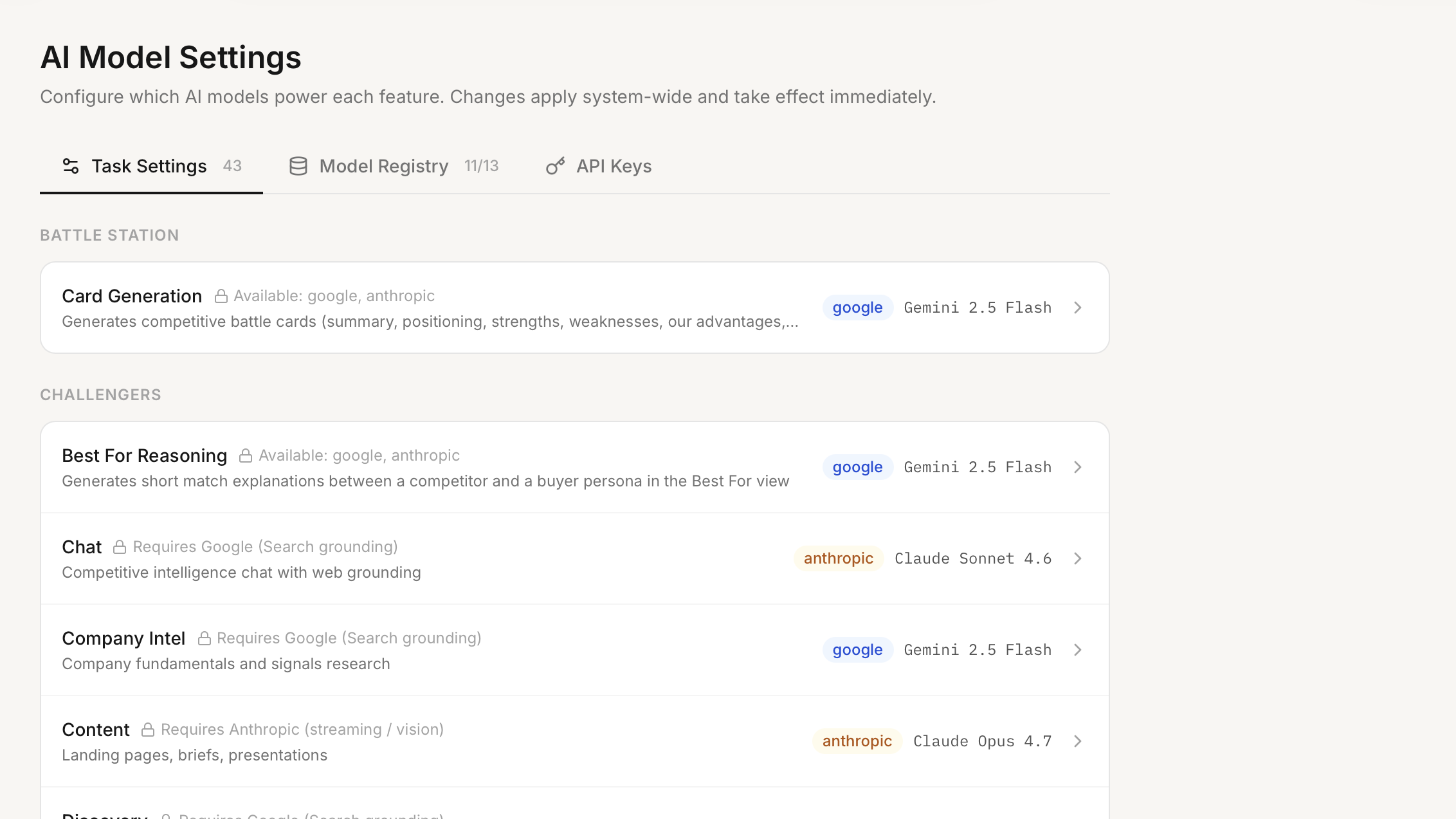
The system is model-agnostic by design.
Fast, efficient models handle search and classification. Frontier models handle the heavy thinking: synthesis, writing, and design. As models improve, Ossia improves without a rebuild.
Humans stay in the loop where it matters.
Nothing goes out under your brand unreviewed. Synthesis products gate on explicit user approval: in Challengers, the AI-generated grid review surfaces findings as individually selectable items and nothing applies to the grid until you click apply; in Market Sizer, research lands in a review state and synthesis cannot dispatch until you sign off on the brief. Continuous monitoring runs on autopilot underneath, surfacing what is material so review time is spent where it counts.
Intelligence is continuous, not episodic.
Markets don't hold still between the times someone remembers to check. Scheduled monitoring sweeps discover, structure, and score what changed, so the system carries the watching, not an analyst with a reminder in their calendar. When something material moves, you regenerate the affected artifact against current data with one click instead of rebuilding it from scratch. The competitive picture stays current by default rather than as-of the last free afternoon an analyst had.
What Ossia produces that a chatbot cannot
This is where the difference stops being philosophical. Ask a generic tool about a market and you get prose. Ask Ossia and you get artifacts that a chatbot structurally can't manufacture, because each one requires external research, an enforced structure, and a memory of what came before.
Competitive grids.
A competitive grid run on your actual market, with a structured feature taxonomy across the full competitor set and persona-fit scoring that resolves which competitor wins for which buyer. Not a paragraph describing competitors.
A boutique strategy firm scoping a category landscape for a client entering veterinary practice management software, a market the firm has never covered. The grid scores nine vendors against one feature taxonomy and resolves which one wins for a single-location clinic versus a multi-site group, so the recommendation holds when the client's head of strategy pushes on it.
Market sizing.
A market size triangulated three independent ways, top-down, bottom-up, and competitive, with a synthesis that reconciles them. Not a single hand-waved number.
A PE associate sizing a niche TAM, compliance software for mid-market European logistics, inside a 14-day exclusivity window. Bottom-up pricing data triangulated against top-down industry reports, every input sourced, ready to defend in the IC.
Battle cards.
Battle cards for each competitor, with talking points generated from the same research that built the grid and an editable objection-handling layer field teams can refine as they hear new pushback.
A product marketing lead at a Series C HR tech company walking into renewal season against two incumbents that just cut prices. Each rep gets a card per competitor with the talking points and an objection-handling layer they update from the field as the new discount lines start showing up in live deals.
Signals feeds.
A living signals feed on the companies and markets you watch, scored for what is actually new.
A competitive intelligence team at a payments company that heard about a rival's stablecoin partnership from a client, three weeks after the press release. The feed now scores announcements across their watched set the week they land, so the next one surfaces as a flagged item instead of an awkward question in the QBR.
A generic box can summarize what you put into it. It can't produce the structured competitive analysis you don't already have, and it can't remember it next quarter.
This is also where enterprise search stops being the same thing. Tools like Glean or Notion AI retrieve documents your firm has already written. That's useful, and it's not this. They surface the competitor memo a colleague wrote last year. They don't build the scored taxonomy across twelve competitors that no one has written yet. Retrieval finds your old text. Ossia structures new market data.
Nothing is trapped. Most artifacts export as formatted PDFs, or as raw markdown that drops into whatever tool your firm uses for final layout, so the structured work lands in the board deck or the model where the last mile actually happens. The system of record holds the intelligence. It doesn't hold it hostage.
And sharing is built in. Where it makes sense, artifacts have a share link: public for prospects and partners, or access-controlled when the audience is sensitive. Viewed in a clean read-only surface, no login or seat required.
A line in the sand
The firms that win at competitive intelligence won't be the ones with access to the best model. Everyone has that now. The winners will turn competitive work into something that accumulates: a taxonomy, a company library, a source trail, a maintained picture of every market that matters to them.
Run competitive intelligence as a system, not an errand.
In closing
When the answer is free, the system is the moat.